The shower is now one of the most important elements in contemporary bathroom design. Practical, space-saving, and suitable even for smaller interiors, it has evolved from a purely functional fixture into a space dedicated to comfort, wellness, and design.
From the simple use of falling water in ancient civilizations to today’s sophisticated modern shower systems, the history of the shower reflects the evolution of hygiene, technology, architecture, and the way we experience the bathroom.
Today, materials, shapes, colors, and innovative installation methods make it possible to create highly integrated shower areas within the modern bathroom. The shower tray has become slimmer, more refined, and in some cases almost invisible, while ceramic increasingly plays a decorative role. As a result, the shower area is now an essential part of contemporary bathroom design.
The origins of the shower: water, hygiene, and ritual
The origins of the shower date back to ancient times.
Civilizations such as the Greeks and Egyptians used water poured from above both for personal hygiene and as part of ritual practices. Although these early systems were very different from the modern shower, the basic concept was already familiar: instead of immersing the body in water, as in a bathtub, water flowed directly over the body from above.
This simple principle would remain at the heart of shower design for centuries.
However, the development of a recognizable modern shower system came much later.
A key moment in the history of the shower is generally identified in 1872, when French physician François Merry Delabost developed a collective washing system at the Bonne-Nouvelle prison in Rouen. The system was designed to improve hygiene while reducing both washing time and water consumption.
From collective facilities, the shower gradually became more widespread and eventually entered private homes.
The rise of the shower in twentieth-century homes
During the twentieth century, the growing availability of domestic plumbing dramatically transformed the bathroom.
Once considered mainly a functional service room, the bathroom gradually became an integral part of the home, designed with increasing attention to comfort, space planning, materials, and aesthetics.
The relationship between bathtub and shower also changed.
For many years, the bathtub was considered the central feature of the domestic bathroom. Over time, however, the shower became increasingly popular thanks to its practicality, lower space requirements, and ability to adapt to bathrooms of different sizes.
This made the shower particularly valuable in compact interiors. In a small bathroom, for example, a carefully designed shower can optimize the available space while maintaining comfort and visual balance.
The shower was no longer simply a place for washing: it began to evolve into a dedicated wellness area.
The modern shower as a key feature of bathroom design
In a modern bathroom, every element contributes to the overall architectural and visual balance of the space.
The shower is no longer necessarily conceived as a separate enclosure. Continuous surfaces, transparent glass panels, large-format wall finishes, and flush-to-floor shower trays help create lighter, more seamless interiors.
The shower tray itself has undergone one of the most significant transformations in contemporary bathroom design.
Traditional raised shower trays are increasingly complemented by ultra-slim models and floor-integrated solutions. These options are particularly suitable for creating a walk-in shower, one of the most popular solutions in contemporary bathroom interiors.
A walk-in shower helps create a more open visual effect, especially when combined with transparent glass and a flush-to-floor shower tray.
The choice of materials has also become increasingly important.
A ceramic shower tray, for example, can coordinate with sanitaryware, washbasins, wall finishes, flooring, and the overall color palette of the bathroom. The shower area therefore becomes a true element of modern bathroom design, rather than a purely technical feature.
Shower design: where function meets aesthetics
Contemporary shower design is increasingly focused on the relationship between water, material, and architecture.
Rather than treating the shower as a simple combination of a shower tray, tapware, and glass panels, designers now approach it as an integrated part of the bathroom environment.
This has led to the development of modular shower systems, decorative ceramic shower trays, slimline solutions, and flush-to-floor shower trays designed to blend seamlessly into the surrounding architecture.
Ceramica Flaminia interprets this evolution through products that explore different ways of using ceramic within the shower area.
Albero, Water Drop, and CM3 represent three distinctive approaches to contemporary shower design: modularity, decorative surface design, and architectural integration.
Albero: a modular shower system that becomes architecture
Albero, designed by Massimiliano Abati, reinterprets the traditional shower area as a modular architectural composition.
The system uses square ceramic elements that can be combined to create surfaces in different sizes and configurations.
Its raised texture performs both a decorative and anti-slip function, while the ceramic shower outlet can be positioned within one corner of the composition.
With Albero, the traditional distinction between shower tray and surrounding surface becomes less defined. Instead, the entire ceramic composition creates and visually identifies the shower area.
This makes Albero particularly suited to contemporary bathroom projects in which modularity, material continuity, and architectural integration play a central role.
Rather than acting simply as a functional element, the shower system becomes part of the overall spatial design.
Water Drop: a ceramic shower tray inspired by water
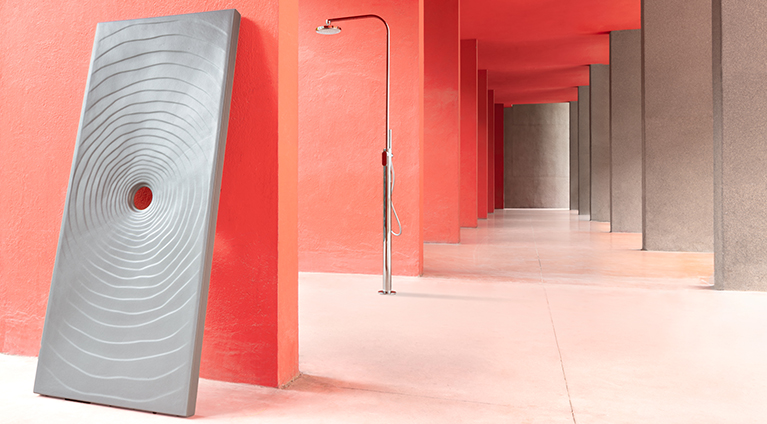
While Albero focuses on modularity, Water Drop, designed by Luca Cimarra, places water itself at the center of the design concept.
The surface of the Water Drop shower tray is defined by concentric raised waves inspired by the ripples created when a drop falls onto the surface of water.
This distinctive texture gives the ceramic shower tray an almost sculptural quality, transforming a traditionally technical bathroom component into a strong decorative feature.
Water Drop is available in different sizes and formats and can be installed either above floor level or as a flush-to-floor shower tray.
This versatility makes it suitable for a wide range of contemporary bathroom configurations, including minimalist interiors and walk-in shower solutions.
The variety of finishes also makes it possible to coordinate the shower tray with the overall bathroom color scheme.
Water Drop demonstrates how contemporary shower design can take inspiration directly from water, transforming movement into form and surface.
CM3: a slim flush-to-floor shower tray for contemporary bathrooms
One of the strongest trends in modern bathroom design is the search for visual continuity.
This has contributed to the growing popularity of slim shower trays, low-profile solutions, and flush-to-floor shower trays.
CM3 responds to this trend with a ceramic shower tray only 3 cm high.
Available in multiple sizes, CM3 can be installed either above floor level or recessed to create a flush-to-floor effect.
Its reduced thickness allows the shower area to blend discreetly into the bathroom architecture, making it particularly suitable for contemporary interiors characterized by clean lines, continuous surfaces, and minimal geometries.
The range of matt finishes and dimensions gives designers greater flexibility when planning the shower area.
As a result, the flush-to-floor shower tray becomes more than a practical solution: it becomes an important design element capable of enhancing the visual continuity of the bathroom.
CM3 is especially suitable for projects where a minimalist walk-in shower or a clean, streamlined bathroom layout is required.
Walk-in showers and flush-to-floor shower trays: a contemporary trend
The increasing popularity of the walk-in shower reflects a broader shift in contemporary bathroom design.
Open shower areas help make the bathroom feel more spacious and visually connected. When combined with a flush-to-floor shower tray, they create a seamless transition between the shower and the surrounding floor.
This approach is particularly effective in minimalist and architectural interiors, where visual continuity is essential.
A low-profile or flush-to-floor shower tray can also make the shower area feel more integrated with the bathroom, reducing visual barriers and creating a more refined overall appearance.
Ceramic is particularly suited to this type of project because it combines durability, visual quality, and design flexibility.
For this reason, the ceramic shower tray continues to play an important role in both residential and contract bathroom projects.
The future of shower design
From the simple flow of water used in ancient times to contemporary design showers, the evolution of the shower reflects a broader change in the way the bathroom is conceived.
Hygiene and functionality remain essential, but they are now accompanied by new priorities: comfort, aesthetic quality, material continuity, personalization, and architectural integration.
The modern shower system increasingly interacts with the bathroom as a whole.
A shower tray can become almost invisible when installed flush with the floor, or it can become a decorative focal point through texture, relief, material, and color.
Modular shower systems can help define the architecture of the space, while slimline solutions make it possible to create lighter and more minimal interiors.
Products such as Albero, Water Drop, and CM3 represent three different expressions of this evolution: modularity, surface design, and visual continuity.
The history of the shower, therefore, is not simply the story of a bathroom fixture.
It is the story of how the bathroom has evolved from a purely functional space into an environment dedicated to wellness, architecture, and contemporary design — where even the everyday experience of water becomes part of the project.