The bathtub is today one of the symbolic elements of domestic well-being. No longer just a functional sanitary fixture, it has become a true protagonist of modern bathroom design—a space dedicated to relaxation, self-care, and everyday pleasure.
However, the bathtub has not always been as we know it today. Over the centuries, its historical and design evolution has profoundly transformed the role of the bathroom within the home, turning it into a place of comfort, style, and contemporary design.
Let us explore the origins, history, and evolution of the bathtub, through curiosities, innovations, and new trends.
The origins of the bathtub
The origins of the bathtub date back to ancient times. The earliest evidence of body-washing systems can be traced to the civilizations of India and Mesopotamia, where complex drainage systems and spaces dedicated to water have been discovered.
It was the Greeks, however, who established the first aesthetic principles of the bathtub: the oldest known stone bathtub dates back to around 1700 BC, followed later by tubs made of metal and terracotta.
During this historical period, the bathroom was not conceived as a private space, but rather as a social place dedicated to meeting and sharing—an idea that was later developed and celebrated by the Romans through their famous bath complexes.
The history of the bathtub over time
With the fall of the Roman Empire, the use of large bath complexes and stone bathtubs gradually disappeared. During the Middle Ages, personal hygiene lost its central role, and the bathtub became a rare object.
In this period, wooden bathtubs became more common—simpler and less comfortable—while a new concept began to emerge: the bathroom as a space dedicated to personal hygiene.
The real turning point came with the modern era and the introduction of running water into homes, which made it possible for bathtubs to spread in private residences and marked the birth of the bathroom as we know it today.
The evolution of the bathtub: from function to design
From that moment on, the evolution of the bathtub never stopped. With the 20th century and the development of industrial design, the bathtub began to transform into a true bathroom furnishing element, taking on increasingly refined shapes, materials, and dimensions.
In recent decades, the bathroom has become a space dedicated to relaxation and well-being, with the bathtub as its ultimate symbol:
– freestanding bathtubs
-minimalist bathtubs
-bathtubs integrated into architecture
-solutions inspired by the spa world
At the same time, the modern shower has gained an increasingly important role thanks to walk-in solutions and advanced technologies. Nevertheless, the bathtub continues to represent a unique sensory experience, closely linked to time, ritual, and personal care.
The bathtub today: innovation and design
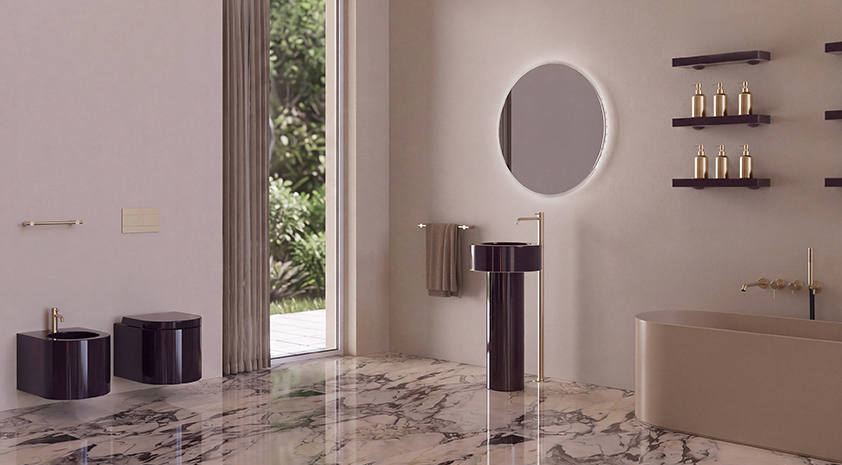
Today, the bathtub is an integral part of a contemporary bathroom system, designed to meet the needs of designers, architects, and end users alike. Modern ceramic sanitaryware collections interpret the bathtub as an essential, coherent element, fully integrated with the surrounding environment.
The most innovative creations—such as the Leggera, Oval, Wash, and Play models designed by Flaminia—embody this evolved vision: solutions that combine formal purity, comfort, and design quality, adapting seamlessly to both residential and contract contexts.
From a simple functional object, the bathtub has evolved into an icon of bathroom design and domestic well-being. Its evolution tells not only the story of hygiene, but also of changing ways of living and experiencing the home.
Today, choosing a bathtub means designing an experience—a moment of pause and intimacy—capable of enhancing the entire bathroom environment.