In the collective imagination bathroom it is a private place where have intimacy with yourself, leaving all thoughts out. An intimate place is supposed to remain covered from the public eye and yet it was the star of numerous works of art.
Previously Flaminia showed you how Degas painted in this place his models, without showing their face, loading their bodies with meanings.
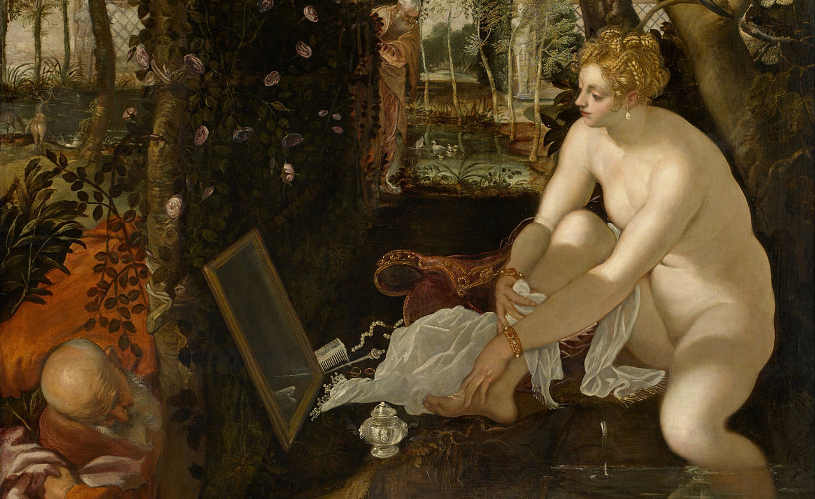
The artist of which we will deal in this study is Jacopo Robusti. Perhaps best known to audiences with his art name, Tintoretto. The painting of Susanna and the Elders dates back to around the mid-sixteenth, narrated in the Greek version of the Book of Daniel. The composition of Tintoretto captures the image of Susanna drying her body, admiring herself in the mirror, in a quiet area of an idyllic garden, completely unaware of the prying eyes of the two elders spying her.
The late Renaissance artist paints an elegant bathroom in the outdoor. The setting is bucolic, emphasized by the clear water of the pool surrounded by lush greenery. The richness of detail, from the Susanna’s earring to her bracelet, from the mirror to the hedge allows Tintoretto to anticipate the Baroque and create a sort of intimate and refined curtain.
What are the next artists who performed during their career the representation of the bathroom in its variants? Keep following Flaminia to find out.
Image source: “Jacopo Robusti, called Tintoretto – Susanna and the Elders – Google Art Project” by Tintoretto – oQElxVov8NZf2g at Google Cultural Institute, zoom level maximum. Licensed under Public Domain via Wikimedia Commons – https://commons.wikimedia.org/wiki/File:Jacopo_Robusti,_called_Tintoretto_-_Susanna_and_the_Elders_-_Google_Art_Project.jpg#/media/File:Jacopo_Robusti,_called_Tintoretto_-_Susanna_and_the_Elders_-_Google_Art_Project.jpg